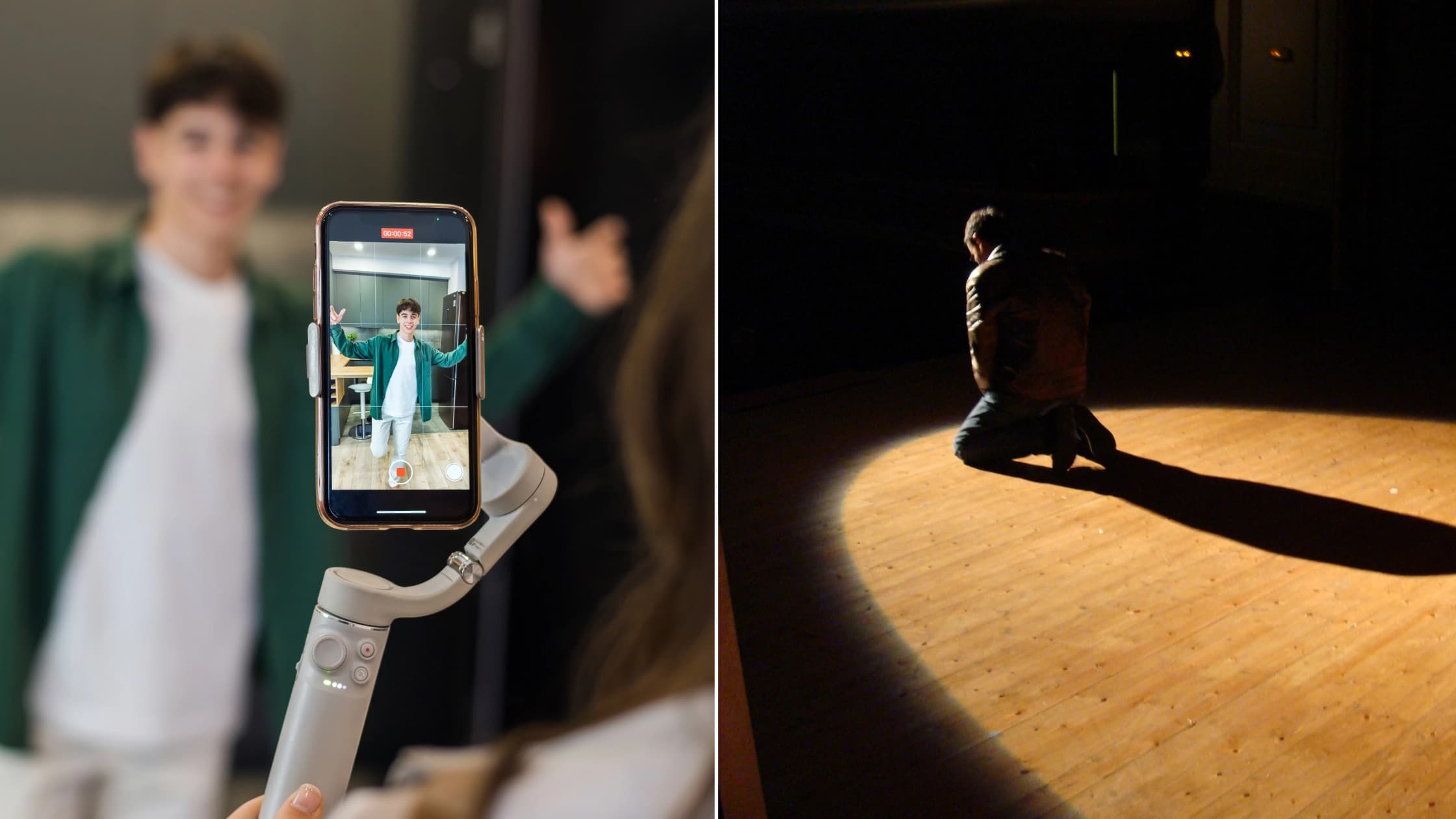
“You’ll be the fat guy in the sitcom… but you’ll never touch art.”
I don’t remember many things verbatim, especially when said over ten years ago. But I sure as shit remember this.
Setting the stage
I graduated from the highly-competitive acting program at DePaul University (1-2% acceptance rate and multiple auditions).
But just getting admitted wasn’t good enough–the first year was a trial to determine who would be invited back to complete the program.
Only the most talented and hardworking actors, decided by the tenured professors, would make “The Cut.” If I remember correctly, twenty-eight of the original forty-two students per class were invited back. (They have since stopped the cut system).
I made the cut, but that was only the beginning of my acting conservatory ass-beating.
We began our second year with “Introduction to Performance” – small-scale “beta” shows before our upperclassmen years in the main casting pool.
Typically, student-directors from the MFA program directed these, but given that our year was causing a buzz for being “especially talented” (I still name-drop Joe Keery as one of my 27 classmates like a loser), we were given professor directors.
And boy, did I “luck” out.
My show was assigned the Destroyer of Actors – A professor who's name I've since redacted, out of respect of her, even though she never requested it. That said... she's known in the space.
Fuck.
Her lore permeated the halls. She was known to absolutely cross-check wannabe actors’ egos into the boards. Destroyed them. A Scorched Earth type director out of a Broadway farce who yells “CUT” or “STOP” mid-scene during a live performance.
Which is exactly what happened to me.
The Reason
Given my weight and acting style I was being cast as the comedic best friend to the leading man type. You know, the one who never has a romantic scene. So I was given the comedic role of Andre in an obscure play, Five Flights by Adam Bock.
I had always hid my weight behind a funny mask, which is what I tried to do during this production.
Bad move.
It may have worked for me in high school or some other bullshit acting program, but not here.
So I was up there. Changing my shirt in the locker room scene. I can’t remember exactly what sparked it, but… I’m up there. Being all insecure with my shirt off trying to make the scene funny in front of the attractive females in my cast/class watching on.
Which is what you would think a comedic actor should do, right? Try to be funny.
No. It’s not what the fuck they do. At least not the good ones. And that’s what I learned on this day.
The Hammer
She was primed to rock me. And so it happened.
My worst fear, and in the worst way. She laid down the hammer on my performance during a dress rehearsal with a partial audience.
I knew it was a microcosm of her larger tactic to shake up the uncut sophomores' fresh "I made the cut!" mindset. You know, keep us motivated and not ungrateful for our achievement. But when she bore into me, it was on a new level.
“STAHHHP! STAHHP. STAHP THE FUCKING SHOW. STAHP....”
She announced.
(Silence for a full five seconds)
“Dahn… Dahn….. Dahn…….”
(Doing her trademark pushing up her glasses with a “Now it’s YOUR turn to get destroyed” knowing smirk).
“You’ll be the fat guy in the sitcom… but you’ll never touch art.”
Everyone in the room: my fellow classmates/castmates not knowing if they should look at me or look away. Shock. My face felt like I'd been in the sun for hours.
Oh. My God.
It actually happened. And likely one of the harshest roasts she gave in a while… if ever.
Had it been post-2016 in the woke, fake outrage era, she’d be reprimanded if I said it made me feel “unsafe” and “fat-shamed” (lol).
The lesson
“Does that mean I’m good?” “Am I like a Kevin James type?” “But is this necessarily a bad thing? Sitcoms make money.” “I think I know what she means to ‘show and not tell’ but how do I do that??”
This was the lesson she was instilling:
Show, don’t tell. And if you know, it will show.
It swirled in my head the next twenty-four hours. So many thoughts plagued me on my bike ride home.
You know how I know it was a defining moment? I can still remember the minor details. My bike tires tracing smooth patterns on the dusted pavement during the season’s first snow. Lost in concern and doubt as I biked at half the speed through Old Town in a soft-focus daze.
I concluded the only solution was to let go… and somehow “know.”
My acting improved two-fold.
It was our next and final dress rehearsal. My last chance to fix whatever I couldn’t fully grasp about “trying” to be funny. So, I did something wildly counterintuitive.
I made comedy serious.
Superb acting is not a popularity contest. It should never involve the actor playing to the audience (or the camera, which is a delayed audience). We act from the character’s point of view (POV); the character is never trying to be funny from the perspective of the story.
Sure, there are moments the character is consciously funny, like we do in life. But as the actor, it’s your responsibility to play from the character's deeper throughline of desires, fears, and dreams.
Your character always pleads their case to get what they want, which is always about fulfilling their dream or controlling their reality, again, like in real life. We're all just confused little humans waddling around trying to avoid suffering and maximize pleasure (the dream).
So… never, ever, ever play to the audience to try at "funny" (like self-aware sitcoms).
Just play to the truth of the character and the given circumstances of the story.
As with so many things in life, this is counterintuitive. For the actor this requires dedicated focus.
Let’s break it down a bit more.
By “I made my comedic acting serious,” I mean I chose to “know” as the actor (not character) – to fill myself with real emotional life. Sanford Meisner calls this “personalization.” Personalization is achieved by applying the circumstances of the play, movie, TV show, or script to analogous or potential circumstances from one’s life grounded in personal facts.
This touches on the Meisner technique–for a deeper dive in another post. Whether it’s Stanislavski, Meisner, or any other method, it's all reduced to the same core principle: Acting requires emotional truth. Fake can never be a substitute. The audience will snuff it out every time.
You must deeply relate to your character’s point of view on an empathetic level. Then… you will know.
From there, the text simply “floats on top”; the truth will simply reveal itself.
This is where extraordinary acting happens—beyond just “good” acting. It’s where the gap between amateurs and professionals widens.
Much like any human pursuit: chess, sports, writing, music, cooking, fashion, programming, directing, photography, architecture, teaching, dance, design, painting, filmmaking, sculpting, engineering, singing, composing, woodworking, martial arts, carpentry, journalism, translation, pottery, animation, editing, gardening, calligraphy, beatboxing, watchmaking, knife-forging, bartending, cosplay craftsmanship—hell, even latte art and speedcubing. There's a "good" and "extraordinary" level to everything. And this is what it is for acting.
You’ll understand this distinction when you watch a scene and think, “Holy shit, that movie was… wow,” versus, “Yeah, the movie was good.”
It's what I do when I perform audiobooks. I’m always personalizing. Not just "acting," or worse, "narrating," which is what many just so-so audiobook narrators do. Sure many narrators can make a book "sound" ok. But they fail to make it a truly emotionally moving work. What I call the “simple golden voice.”
Some examples
Here are some examples of “serious” comedic acting that are my personal favorites for their hilarity (Ben Stiller is a master of his craft):
- Ben Stiller in Heavyweights
- Ben Stiller in Dodgeball (rumored to be the same character)
- Justin Long in Sasquatch Gang (Joey Kern is also hilarious as ‘Shirts’)
- John C. Reilly in Step Brothers (Went to DePaul’s Acting program as well)
These are different from sitcom because they’re not waiting for a laugh track after delivering a line. They are committing 100% to the seriousness of their characters’ POV.
Opening Day Micro-Fame
I “applied” this, and the sudden change blew her away. She said I was an instantly transformed actor. I thought she was just juicing me up because she felt bad about what she’d the previous day. But no.
No BS with her, ever.
And my classmates agreed. I was way better (and funnier).
The adjustment felt strange, like when you first learn to ride a bike without training wheels. I wasn’t actively trying to be funny, but passively, by "knowing."" And it worked.
Opening day came, and the show had to stop because of the laughter my scenes caused. Really.
There was one particular scene where my character, Andre, suddenly interrupts his closeted gay teammate (the lead) and his lover’s date, asking if they finally kissed. He says no, and Andre’s one line of disappointment was simply: “Oh.” To then exit stage right while eating a Rice Krispie treat.
I committed to Andre being upset that his teammate and friend wasn’t “going for it.” I delivered the line in seriousness as the character, but with full awareness of the comedy as the actor.
The way I delivered the “OH.” was inexplicable. But one thing I do know: I was committed to the scene. I wanted my best friend to feel comfortable in his own skin.
That was my truth. And I was frustrated he wasn’t stepping up.
With that driving my "know," the comedy floated on top, and it worked. Stakes: Raise the stakes. Take the scene seriously from the character’s point of view, and boom—you’re done.
The upperclassman approval I so craved came in spades. (Oh, us insecure actors need everyone’s approval, don't we.) Word spread and we were packed for the rest of the show’s run.
Everyone wanted to see this hilarious Dan Lewis guy.
The Sitcoms of 2025
Fast forward to now – ten years later – and sitcoms have morphed into social media and influencers.
Ever scrolled through social media and stumbled on a “funny” video with millions of views, only to think, “How do people find this brainrot funny?”
Here’s the thing: these “influencers” will struggle to maintain their views over time. But the truly extraordinary ones – the ones who connect to humanity and truth – will endure.
They tap into something deeper by avoiding the trap of doing the same tired schtick over and over (even though the algorithm rewards schticks – yet another reason why humanity is completely cooked).
And sure, not all influencers are actors, but you know what I mean. The ones who commit to creating with genuine intention rather than just chasing likes are the ones who will go further.
My Personal Conflict
I am torn between playing the social media game and simply posting real art and comedy on this website. Because I, too, have become a victim of the algorithm that rewards views for the dumbest things. I even experimented with a character named "cringefluencer" on TikTok (link to profile below).
I need to play the game – but always try to morph it into something meaningful. Actual art. Comedy with a character who’s being serious.
Otherwise, I’d be a massive hypocrite.
We’ll see.
Now it’s your turn to stop trying.
If you’re an actor or an acting hopeful, you can learn to elevate your craft—even if it’s just for social media.
What would it look like to commit to the truth of the scene instead of pandering to your audience? To stop chasing fame for fame’s sake?
In other words, to actually display skill and talent?
The natural response is, "Yeah, I know. I already do that.” To which my now hardass response is: shut tf up. That’s insecurity not truth.
Commit to the truth. The truth that lives in you. And forget the rest.
TL;DR:
To be a funnier actor, take the character’s point of view (POV) seriously. Never play to the audience. Stifle your actor ego. Focus. Raise the stakes. Play actions on your partner. And boom – real(er) comedy.